
Moving into a small bedroom feels manageable at first. Then, gradually, things accumulate. Clothes pile up on the chair. The closet stops closing properly. The floor disappears under bags and shoes. And suddenly a small bedroom doesn’t just feel small — it feels chaotic.
I’ve lived in small bedrooms for most of my adult life, and storage has always been the thing that made or broke the experience. When it’s done well, a small bedroom can feel surprisingly comfortable and organized. When it’s not, even a beautifully decorated room feels stressful.
Here’s everything that’s actually worked for me.
The Space Under Your Bed Is Prime Real Estate — Use It
Most people waste the entire area under their bed. It’s one of the largest storage zones in a small bedroom and it’s completely invisible — meaning whatever you store there doesn’t add any visual clutter to the room.
What works well under the bed:
- Flat storage bins on wheels that slide in and out easily
- Vacuum-sealed bags for seasonal clothing and extra bedding
- Dedicated shoe organizers designed for under-bed use
- Shallow rolling drawers for items you access regularly
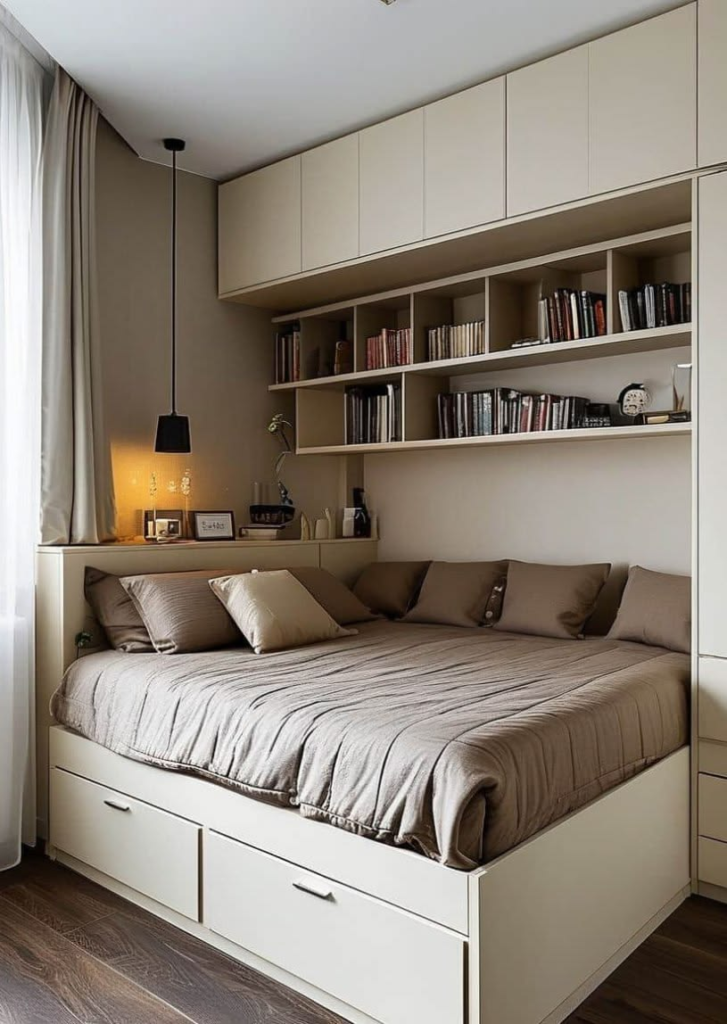
If you’re buying a new bed frame, seriously consider one with built-in drawers. The storage they provide is genuinely significant — it can eliminate the need for a separate dresser entirely in very small rooms.
The one rule: keep it organized. Under-bed storage that becomes a random pile defeats the purpose. Use bins and label them so you know exactly what’s where.
Choose Furniture That Does More Than One Job
In a small bedroom, every piece of furniture needs to justify its presence. If something only does one thing, ask yourself whether a piece that does two or three things could replace it.
Multi-functional furniture that’s worth considering:
- Storage beds with drawers built into the base — eliminates the need for a dresser
- Storage ottomans at the foot of the bed — seating, footrest, and hidden storage in one
- Nightstands with drawers rather than open shelves — keeps the surface clear and provides concealed storage
- Storage benches — a place to sit while dressing plus internal storage for extra bedding or seasonal items
- Lift-up beds — the entire mattress lifts to reveal a large storage area underneath
When every piece serves multiple purposes, you can have fewer pieces overall — which makes the room feel larger.
Floating Shelves — Storage Without Taking Floor Space
Floor space is your most valuable resource in a small bedroom. Every piece of furniture that sits on the floor claims some of that space visually, even when it’s not in the way physically.
Floating shelves solve this. They’re mounted directly to the wall, leaving the floor completely clear, and they provide real, usable storage for books, plants, decorative items, and everyday essentials.
A few floating shelves above the desk, beside the bed, or in an otherwise empty corner can add significant storage without the room feeling any more crowded. They also tend to look clean and intentional — much more so than a shelf unit sitting on the floor.
Go Vertical — Most People Only Think Horizontally
When floor space runs out, the natural instinct is to get rid of things. The better instinct is to look up.
Vertical space — the wall area above typical furniture height, going up toward the ceiling — is almost always completely unused. Tall shelving units, wall-mounted cabinets that reach high, hanging storage systems, and over-the-door organizers all use this vertical space effectively.
In a small bedroom, a tall narrow bookshelf takes almost no floor space but provides considerable storage. A wall-mounted cabinet above the existing furniture line adds storage without changing the feel of the room at ground level.
The principle is simple: when you can’t expand sideways, expand upward.
Rethink Your Closet — It’s Probably Not Working as Well as It Could
Most standard closets are dramatically underutilized. A single hanging rod and a shelf above it wastes the majority of the available space. With a few affordable additions, a small closet can hold significantly more.
Changes that make a real difference:
- Double hanging rods — one at standard height for longer items, one below for shirts and folded clothes
- Shelf dividers to keep stacks of clothing from toppling
- Drawer inserts or small boxes on shelves to organize smaller items
- Hanging shoe organizers on the inside of the closet door
- Hooks on the side walls of the closet for bags, belts, and accessories
A properly organized closet can sometimes reveal enough hidden capacity that you need significantly less furniture in the bedroom itself.
The Back of the Door Is Storage You’re Not Using
The inside of the bedroom door is a genuinely useful storage surface that most people completely ignore. An over-the-door organizer with pockets or hooks turns this unused space into accessible storage for shoes, accessories, bags, or everyday items you want within easy reach.
These organizers are affordable, easy to install without any tools, and completely invisible when the door is open. It’s one of the easiest storage wins available in a small room.
A Storage Headboard Replaces Bedside Furniture
Standard bedside tables take up floor space on both sides of the bed — in a small bedroom, that can feel significant. A headboard with built-in shelving solves this elegantly.
A storage headboard provides space for books, a phone charger, a glass of water, and a small lamp — everything a nightstand would hold — without any additional floor furniture beside the bed. The floor on both sides stays clear, which makes the room feel noticeably more open.
Use Your Corner Spaces
Corners are consistently underused in small bedrooms. The corner is often just dead space where nothing goes — but it’s actually a perfectly good location for a corner shelf unit, a small reading chair, or a narrow storage tower.
Corner shelves in particular are useful because they use space that genuinely has no other purpose. A few corner shelves filled with books and a plant can turn an empty corner into a functional, attractive part of the room.
Storage Baskets — Simple, Attractive, Effective
Baskets get dismissed as a basic solution, but they’re genuinely useful. A good basket on a shelf or in a corner groups related items together, makes them easy to grab as a unit, and looks far neater than loose items scattered around.
In a bedroom, baskets work well for:
- Extra blankets and throws
- Items that don’t have a better home
- Hair tools and accessories
- Books and magazines you’re currently reading
- Laundry that hasn’t made it to the hamper yet
Choose baskets in natural materials — woven seagrass, rattan, or cotton — and they become part of the room’s aesthetic rather than just functional containers.
Keep Surfaces Clear — It Changes Everything
One of the most effective storage habits in a small bedroom is maintaining clear surfaces. A cluttered nightstand or dresser top immediately makes the room feel smaller and more chaotic, regardless of how organized everything else is.
The rule I follow: nightstand gets a lamp, one book, and nothing else. The dresser top stays completely clear or has a single tray with two or three items maximum.
Everything else finds a drawer, a shelf, or a basket. It takes discipline to maintain, but the visual result is worth it.
Organize Drawers Properly — You’re Probably Wasting Half the Space
Most dresser drawers are used inefficiently. Clothes get tossed in, stacked loosely, and within a week the drawer is a jumbled pile where finding anything requires excavation.
Drawer organizers — simple dividers that separate the drawer into sections — solve this completely. Folding clothes vertically rather than stacking them horizontally is another change that makes a significant difference: you can see every item immediately rather than only seeing the top layer.
These are small changes that make drawers hold more and stay organized far longer.
Floating Nightstands Free Up Floor Space
If standard nightstands feel too bulky for your room, floating alternatives — small shelves mounted to the wall beside the bed at the right height — provide the same function without touching the floor.
The visual effect of clear floor space on both sides of the bed makes the room feel more open and less crowded. Combined with a storage headboard, you can eliminate bedside furniture from the floor entirely.
Declutter Regularly — Storage Systems Can’t Do Everything
Even the most perfectly organized storage system gradually fills up if you’re not regularly reviewing what you actually need. In a small bedroom, items accumulate quickly — clothes that no longer fit, things bought and never used, items kept out of habit rather than genuine usefulness.
A simple seasonal declutter — going through clothing, accessories, and stored items every few months — keeps the storage system functioning properly. The goal isn’t to own as little as possible; it’s to only store things you genuinely use and need.
Common Small Bedroom Storage Mistakes
Things that consistently make storage less effective in small bedrooms:
- Buying oversized furniture that dominates the room and reduces the sense of space
- Ignoring vertical wall space and only thinking horizontally
- Overcrowding shelves so they look cluttered even when organized
- Keeping items you don’t use because getting rid of them feels wasteful
- Neglecting under-bed space — the single largest hidden storage area in most bedrooms
- Leaving closets unoptimized while buying additional furniture to compensate
Frequently Asked Questions
How can I add more storage to a small bedroom without making it feel crowded?
Focus on hidden and vertical storage — under the bed, on the walls, inside furniture with built-in compartments. These approaches add storage capacity without adding visual bulk to the room.
What’s the most effective single storage upgrade for a small bedroom?
Under-bed storage, particularly a bed frame with built-in drawers, tends to deliver the most significant gain. It adds substantial hidden storage without using any additional floor space.
How do I keep a small bedroom organized long-term?
The key is having a designated place for every item — when everything has a home, putting things away becomes automatic. Pair that with a seasonal declutter and the system stays manageable.
Is it worth investing in built-in storage for a small bedroom?
If you own the property and plan to stay long-term, built-in wardrobes and custom shelving are excellent investments. They maximize storage far more efficiently than freestanding furniture and tend to make the room look cleaner and more intentional.
Final Thoughts
A small bedroom with good storage doesn’t just function better — it feels better. When everything has a place, when surfaces are clear, and when the floor isn’t competing with furniture for space, even a compact room can feel genuinely comfortable and calm.
The approach that works best is layered: start with the hidden spaces (under the bed, inside doors, in the closet), add vertical wall storage where the floor is already full, and choose furniture that earns its place by doing more than one job.
Small bedrooms don’t require compromise. They just require a bit more intention.